Zelle’s Court-Order Ban: What It Means for New York Child Support and Spousal Support Payments
Many New Yorkers use Zelle the same way they use cash. It is fast, simple, and feels informal. That convenience becomes a problem the moment the payment is not informal, meaning it is court-ordered child support, spousal support, or maintenance.
As of April 2026, Zelle’s terms now classify court-ordered support payments as a prohibited use. If you are paying support under a New York Family Court order or a Supreme Court divorce judgment and you are using Zelle to do it, you are taking on a risk that can snowball into arrears, enforcement action, and unnecessary litigation.
This is one of those issues where people do not feel the danger until the day the transfer fails, the account gets restricted, or the recipient cannot request funds anymore. Then it becomes a crisis, usually right before a payment is due.
The New Zelle Policy
Zelle’s user terms prohibit using the service for court-ordered payments, including alimony and child support, and prohibit requesting those payments through the platform. Zelle also states it can suspend or terminate access if it believes you are using the service in a way that exposes it or participating financial institutions to liability or risk.
Even if you have been paying support by Zelle for months or years without a problem, that history does not protect you if Zelle or your bank decides your activity violates the service agreement.
New York support enforcement is built around predictability and documentation. A missed payment is rarely treated as “no big deal.” It is treated as arrears, and arrears trigger a serious enforcement ecosystem.
For child support cases payable through the Support Collection Unit, New York’s system is explicit about crediting and timing. Amounts collected by the SCU reduce the obligation dollar-for-dollar, and the date of collection is the date the payment is received by the SCU. That is one reason the state system exists. It creates a clean ledger and a clear timeline.
Zelle does the opposite. It is not designed to generate a court-friendly ledger. It is designed for quick person-to-person transfers between people who trust each other. When the transfer is restricted or the account is suspended, you may have no way to pay that month unless you have a backup method ready.
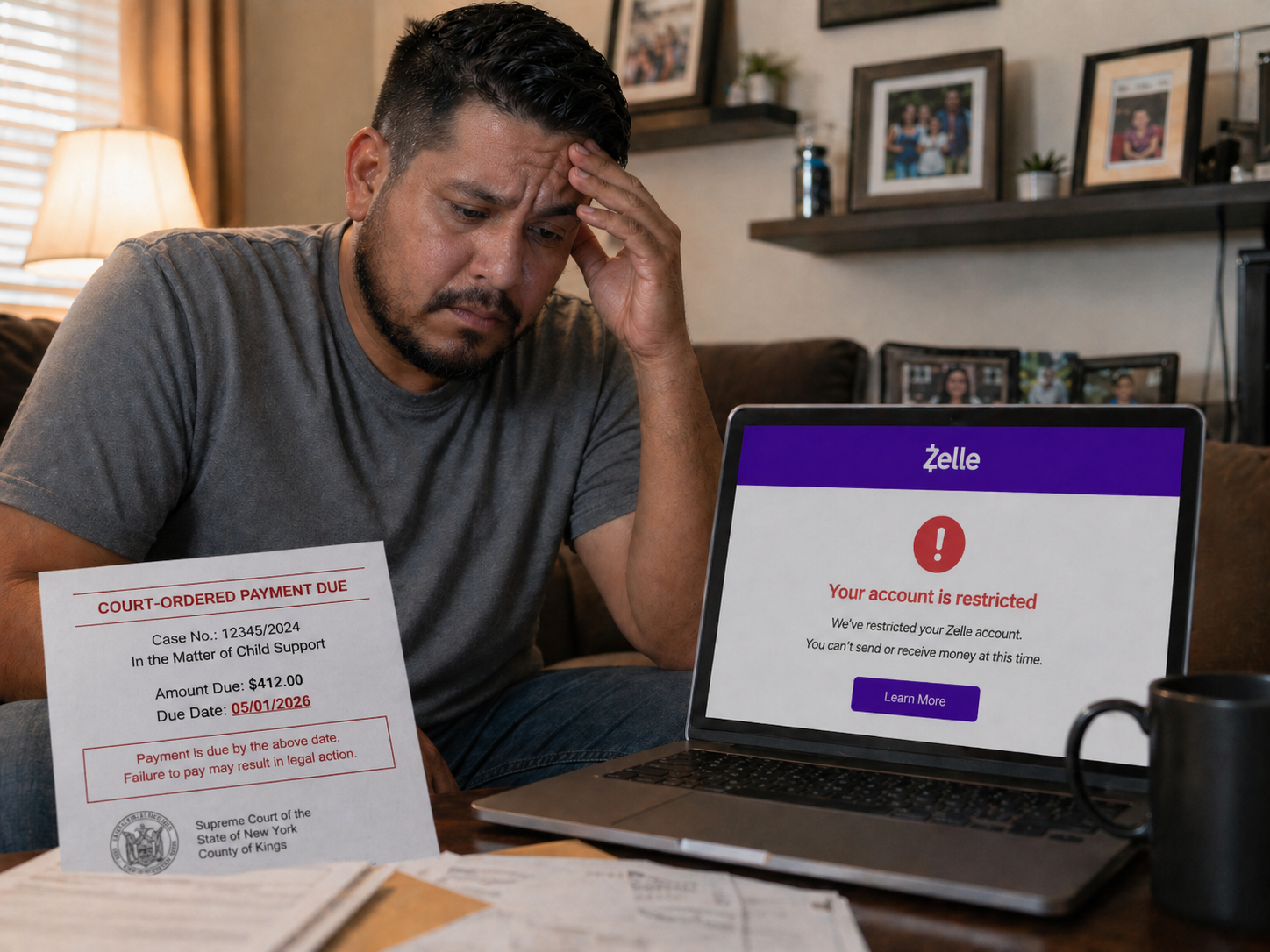
The Real-World Damage When Zelle Payments Stop Working
When Zelle blocks, delays, or terminates access, the harm usually falls into three buckets.
First, the payor gets exposed to arrears and enforcement pressure. New York’s child support program has multiple administrative enforcement tools for overdue support, including tax refund intercepts, passport denial for larger arrears, freezing financial assets, and license suspension processes, among others. Once a case turns into an enforcement posture, it becomes more expensive and more adversarial than it needed to be.
Second, the recipient has a cash-flow problem. Support is often what keeps rent paid and routines stable. If support has been coming in by Zelle and suddenly the payor says “I can’t send it, Zelle won’t let me,” the recipient is forced into emergency choices, and that often means going back to court.
Third, both parties inherit a documentation fight. If payments were made outside SCU, the parties can end up litigating proof, timing, and characterization. Was it child support or “money for the kids”? Was it partial support? Was it a gift? Was it reimbursement? Zelle memos help, but they are not a substitute for an SCU ledger or a structured payment method that courts consistently trust.
Spousal Support and Maintenance Are Not Immune
A lot of people assume that payment restrictions apply only to child support. That is wrong. Zelle’s prohibition explicitly includes court-ordered amounts for alimony or child support.
New York’s support collection structure also recognizes “child and spousal support” as part of what SCUs may collect and disburse. In other words, the state system is built to handle these payments cleanly, while Zelle is expressly telling users not to use the service for them.
If your divorce judgment or support order requires maintenance, or if you have a pendente lite support order during a divorce, relying on Zelle is now a self-inflicted risk.
The Practical Fixes That Actually Work in New York
If your order is payable through the Support Collection Unit, the cleanest move is to use the official channels designed for support payments. New York State offers online payment options and mail-in payments for child support cases, and income withholding remains the dominant collection mechanism statewide. The point is not convenience. The point is that the system creates indisputable crediting and a court-accepted record.
If your order is direct pay, meaning payments are made directly between parties and not through SCU, you should still transition away from Zelle. A bank-to-bank transfer method that is not governed by a consumer P2P platform’s prohibited-use policy is usually the safer structure. In many cases, that means setting up recurring payments through bank bill pay or ACH transfers, with consistent memo language that matches the order.
If you and the other parent or spouse have been using Zelle by agreement, you should treat this as a compliance update, not as an invitation to fight. The smart move is to switch to a method that cannot be unilaterally shut off by a private platform’s terms. If the other side resists, that is often a warning sign, because the only person who benefits from a non-trackable or interruption-prone payment method is the person who wants leverage later.
A Note About Court Orders and “Accepted Past Practice”
Some people will say, “We have always used Zelle, the other side accepted it, so it’s fine.” Acceptance does not control platform rules. Zelle can still restrict access. And once payments become irregular, “past practice” arguments often fail to protect you from arrears claims or enforcement steps, especially if the order has a defined due date and amount.
If a judgment or order specifically requires payments through SCU, using Zelle is not just risky, it is usually noncompliant. If the order is silent, you still want the most defensible and stable payment method, because support disputes are often decided on records, not on intent.
What New York Clients Should Do Right Now
If you are paying child support or spousal support in New York and you are using Zelle, assume that you may lose that ability at the worst possible time, meaning right before a payment is due, or during a conflict, or right before court. The safest approach is to shift to a payment method that will not be flagged as prohibited by a private platform and that produces clean, admissible records. The official NY child support payment infrastructure exists for a reason, and the enforcement system that follows missed payments is not theoretical.
If you are receiving support and your ex is paying by Zelle, you should understand that you are relying on a platform that is now explicitly telling users not to do what you are doing. That can create sudden interruptions and put you in a defensive posture when you should be planning, budgeting, and moving forward.